


Introduction to Epic Games and Steam: The Giants of PC Gaming
The world of PC gaming in 2025 is dominated by two giants: Epic Games and Steam. Both platforms serve as major PC gaming platforms, transforming how gamers access and interact with their favorite titles. The Epic Games Store, launched in 2018, quickly rose to prominence with its strategy of exclusive game releases and competitive revenue splits, appealing to developers and gamers alike. Available for free, many users are drawn to its weekly game giveaways and game discounts, which solidify its position within the digital game stores ecosystem.
Conversely, Steam has been a cornerstone in PC gaming since its inception in 2003. Known for its extensive Steam library and community features, it remains the quintessential game distribution platform. Steam’s robust infrastructure supports a wide range of gaming experiences, from indie titles to blockbuster franchises, contributing to its vast gaming market share. With ongoing debates over game curation and store policies, both platforms continually evolve to cater to the rapidly changing landscape of PC game sales.
Epic Games and Steam set the stage for a competitive online gaming marketplace, compelling players to continually assess their value. For an in-depth look at how another trend is shaping gaming experiences, check out our comprehensive guide on AI tools in 2025: Top 12 AI Tools of 2025 with Real Use Cases. For more insights into PC gaming and industry dynamics, visit reputable sources like PC Gamer.
The Evolution of Epic Games and Steam: A 2025 Perspective
In 2025, the dynamic world of PC gaming platforms, particularly the Epic Games Store and Steam, has undergone substantial transformations, both striving to dominate the online gaming marketplace. Since its inception, Epic Games has consistently challenged the establishment by offering exclusive game releases and lucrative game discounts. These strategies have helped it carve a formidable niche in the gaming market share, compelling Steam to innovate and retain its extensive Steam library.
Steam has responded by enhancing its game distribution platform, incorporating cutting-edge technologies and expanding community features to augment user engagement. Now offering more personalized recommendations and community-driven content, Steam continues to captivate its massive user base.
Meanwhile, the Epic Games Store has capitalized on aggressive PC game sales and partnerships with developers, providing a more enticing revenue share model than its rivals. This evolution has propelled Epic into a significant contender within digital game stores. For gamers exploring new builds to optimize their gaming experience, consider checking out our Best $1000 Gaming PC Build 2025.
As both platforms strive for supremacy, 2025 exemplifies an era where PC gamers are the true beneficiaries, enjoying diverse offerings, increased options, and competitive pricing. For further insights on the evolving gaming ecosystem, refer to industry analyses by PC Gamer.

Market Share Analysis: Who Dominates the PC Gaming Landscape?
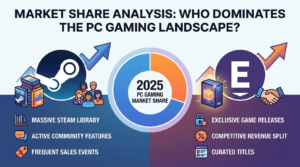
As we delve into the competitive realm of PC gaming platforms, understanding the market share dynamics between Epic Games Store and Steam is crucial. In 2025, the landscape is marked by a palpable rivalry as both platforms vie for dominance. Steam, with its vast Steam library and established user base, continues to lead the market. However, the Epic Games Store is making significant inroads, leveraging exclusive game releases and strategic game discounts to entice users.
Currently, Steam maintains a stronghold in PC game sales, thanks to its extensive catalog and robust community features. Meanwhile, Epic Games’ approach to curating exclusive titles and offering attractive revenue shares to developers has expanded its footprint in the online gaming marketplace.
- Steam: Known for its massive library, active community, and frequent sales events that attract millions of users worldwide.
- Epic Games Store: Gains traction with strategic exclusives and competitive revenue splits, appealing to both developers and gamers alike.
For more insights into optimizing your gaming setup, explore our Best $1000 Gaming PC Build 2025 guide.
For an in-depth understanding of the ongoing battle between these digital game stores, visit GamesIndustry.biz and explore their comprehensive analysis.
Game Libraries: Comparing Epic Games vs. Steam Offerings
As PC gaming platforms evolve, the vast libraries of the Epic Games Store and Steam play a crucial role in shaping the gaming experience. In 2025, these digital game stores continue to vie for the attention of gamers worldwide with their extensive and diverse selections.
Steam Library: A Veteran’s Repository
The Steam library stands as one of the most comprehensive in the gaming market, boasting thousands of titles ranging from indie gems to blockbuster hits. This game distribution platform has long dominated the PC gaming landscape by offering accessibility and frequent game discounts. Moreover, its robust community features, such as reviews and forums, empower gamers to make informed purchasing decisions. Steam’s dedication to personalization, reflected in its enhanced recommendation algorithms, ensures users continually discover games that match their interests.
Epic Games Store: A Competitive Challenger
Contrastingly, the Epic Games Store has carved a niche by securing exclusive game releases and delivering enticing weekly free games. While its total game library may not yet rival Steam’s, Epic Games is committed to attracting developers with favorable revenue splits. This strategic move is helping it gain gaming market share rapidly. Additionally, for those interested in optimizing their gaming setups, check out our Best $1000 Gaming PC Build 2025: High FPS Parts List.
To explore a thorough analysis comparing PC game sales strategies between these two giants, see this insightful article on their evolving approaches.

Exclusivity Wars: Epic Games Store vs. Steam in 2025
The competition between Epic Games Store and Steam in 2025 has intensified over the battle for exclusive game releases. This rivalry has emerged as a focal point in the realm of PC gaming platforms. The Epic Games Store has continued its strategy of securing time-limited exclusive deals, capturing titles from both indie developers and major studios. This approach has effectively drawn attention from Steam’s colossal Steam library, sparking lively debates among gamers.
The strategy has been effective in shifting some gamer attention to Epic’s game distribution platform. Notably, gamers have shown an increased willingness to engage with new platforms should it mean accessing coveted titles earlier than others. On the other hand, Steam focuses on leveraging its expansive ecosystem of PC game sales and community features to retain its audience. Their approach highlights the value of convenience and continuity of gaming market share, alongside attractive game discounts and comprehensive Steam library.
Understandably, this competition influences decisions beyond individual players; developers and publishers must weigh potential benefits against broader audience reach. As this online gaming marketplace battle wages on, the ecosystem of digital game stores evolves, with implications for the future of PC gaming.
For details on optimizing your gaming setup, explore our latest build guides like the Best $1000 Gaming PC Build 2025. For more insights on the gaming industry, check CNET’s analysis of Epic Games vs. Steam.
User Experience: Steam vs. Epic Games Interface and Features
As 2025 unfolds, the battle for dominance in the PC gaming platforms sphere intensifies between Epic Games Store and Steam. Both platforms are making strides to enhance user experience through their unique interfaces and features. The Epic Games Store continues to evolve with a sleek, minimalistic design focused on ease of navigation, while Steam remains rooted in its vast ecosystem and customization options.
Steam’s interface benefits from its extensive Steam library, superior community features, and a plethora of user-generated content. Discoverability of games, integrated reviews, and user forums build an appealing ecosystem for gamers seeking a comprehensive game distribution platform.
In contrast, Epic Games, seeking to carve its niche, entices users with exclusive game releases, regular free titles, and aggressive game discounts. These features make it a compelling choice in the online gaming marketplace and help increment its gaming market share.
Both platforms offer distinct advantages, with Steam catering to a community-driven experience, and Epic providing high-value digital game stores incentives. As reported by PC Gamer, understanding each platform’s strengths is crucial for gamers who aspire to maximize their PC game sales options and enrich their digital collections.
Pricing Models and Discounts: A Detailed Comparison
The battle for supremacy between Epic Games and Steam in 2025 has intensified, particularly in pricing models and discounts. Both platforms have adopted strategic approaches to attract their share of the burgeoning PC gaming platforms market. However, which digital game store offers gamers better value for their money?
Steam’s Traditional Pricing and Seasonal Sales
The Steam library continues to dominate as a highly favored game distribution platform due to its well-established pricing strategy. Steam offers a plethora of sales, including its legendary Summer and Winter sales, which provide users with deep discounts on thousands of games. This formula has made Steam synonymous with irresistible PC game sales. Such events in the online gaming marketplace help it maintain a substantial gaming market share. Nevertheless, discerning gamers should visit our 2025 gaming PC build guide for an optimal gaming experience.
Epic Games Store and Its Competitive Edge
Epic Games Store, known for its competitive pricing, has revolutionized the norm by offering exclusive game releases with attractive discounts. The store’s policy of free games each week has made Epic a fierce contender against Steam’s dominant presence. These strategies are aimed at increasing its gaming market share, especially among new users who might prefer trying new titles without any initial investment.
For those interested in understanding the dynamics of epic pricing strategies, an insightful resource is Polygon’s exploration of Epic’s pricing dynamics.
Community and Social Features: Which Platform Reigns Supreme?
In 2025, the battle between Epic Games and Steam extends beyond game libraries and discounts, delving into the vibrant world of community and social features. This comparison is crucial for PC gaming platforms aiming to capture the hearts of online gamers. Steam, with its long-established Steam library, leads in community engagement. It offers a robust infrastructure with forums, groups, and a thriving indie developer community, fostering direct interactions among gamers and creators.
The Epic Games Store, however, is not far behind. Despite its late entry into the game distribution platform arena, Epic Games has introduced innovative social features. With Epic’s focus on cross-platform play and party chat functionalities, it provides a seamless experience for gamers looking to connect and play with friends across different devices.
While Epic Games has made significant strides, Steam’s extensive features like community-driven guides and user-generated content continue to dominate. For those interested in understanding how digital evolution affects cybersecurity in gaming, our guide on cybersecurity myths in 2025 provides crucial insights.
Ultimately, both platforms exhibit unique strengths in the online gaming marketplace. As a dominant force in the gaming market share, Steam remains unparalleled in its community offerings. However, Epic Games continues to innovate, promising an exciting future for digital game stores. For a deeper dive into this evolving competition, check out this analysis by PC Gamer.
Developer Revenue and Support: Epic Games Store vs. Steam
In the fierce competition between PC gaming platforms, a critical aspect for game developers is the revenue share and support offered by these digital game stores. As of 2025, both Epic Games Store and Steam strive to attract developers with competitive revenue models and support structures.
The Epic Games Store continues its industry-disrupting revenue split, offering developers an 88% share of their PC game sales, leaving only 12% as a platform fee. This attractive model encourages more exclusive game releases on the Epic platform, thus diversifying its gaming market share. Additionally, Epic Games has been known for its proactive developer support, encompassing marketing resources and development tools.
On the other hand, Steam maintains its traditional 70/30 split, but offers a comprehensive set of tools through its Steamworks suite, which remains a staple for developers due to its robust capabilities and vast Steam library integration. Despite its higher cut, Steam’s massive audience and established community features remain a significant draw for many developers.
Understanding the nuances of each online gaming marketplace can significantly affect a developer’s decision-making process. For more insights into how technology affects your business, explore our guide on the rise of no-code APIs.
For more information on game distribution platform strategies, visit Polygon’s analysis of the ongoing Epic Games vs. Steam rivalry.
Gaming Technology Advancements: Epic Games vs. Steam in 2025
As PC gaming platforms continue to evolve, 2025 marks a remarkable year for both Epic Games Store and Steam in terms of technological advancements. These game distribution platforms are locked in a constant battle for dominance in the digital game store sector, each pushing the boundaries of gaming technology.
The Epic Games Store has been at the forefront of integrating virtual reality and augmented reality experiences into its offerings. This new venture has resulted in a lineup of exclusive game releases designed to revolutionize how gamers interact with their environments. Their investment in cloud gaming technology ensures that high-quality graphics and seamless gameplay are accessible even on lower-end devices, broadening their market share significantly. Additionally, Epic’s strategic partnerships provide exclusive game releases that entice users with irresistible technology perks.
On the other hand, Steam is leveraging its vast Steam library by incorporating enhanced machine learning algorithms that curate personalized gaming experiences. Their innovations in social connectivity tools allow players to seamlessly interact with friends through virtual spaces, expanding the traditional multiplayer experience. Furthermore, Steam’s unique approach to integrating blockchain technology into its platform enhances security and enables a new dimension of virtual asset trading.
In this epic showdown between Epic Games and Steam, technology plays a crucial role. For a broader glimpse into how technological advances are shaping different sectors, explore our article on building a low-power home server. To stay updated on the latest trends in gaming and technology, check out GamesRadar as an external authority source for industry insights.
Customer Support and Service Quality: Which Is More Reliable?
As the gaming community grows, quality customer support has become a paramount feature in choosing a digital game store. For PC gaming platforms like Epic Games Store and Steam, excellent service quality can significantly influence user satisfaction and loyalty in 2025.
Steam, with its comprehensive Steam library, has long been recognized for its robust customer support infrastructure. Players can access a myriad of resources, from extensive FAQs to community forums where seasoned gamers and newbies exchange insights. Their refund policy is straightforward, ensuring solutions are timely and efficient. Additionally, Steam’s community-driven approach fosters a self-sustaining support mechanism.
Conversely, the Epic Games Store has been steadily improving its customer support, aiming to match its competitor’s prowess in the game distribution platform arena. It offers direct support channels and prioritizes quick resolutions for queries related to PC game sales and exclusive game releases. Moreover, the store’s commitment to maintaining high service standards has bolstered its position in the online gaming marketplace.
For a deeper dive into technical support aspects, you might want to check our guide on solving connectivity issues. Both platforms, however, continuously work on enhancing their support frameworks, a crucial effort in securing their gaming market share. For more detailed comparisons, PC Gamer’s analysis on Epic Games and Steam provides further context.
Integrations and Plugins: Enhancing the Gaming Experience
In the dynamic landscape of PC gaming platforms, integrations and plugins play a pivotal role in bridging gaps between gamers and their desired experiences. In 2025, both the Epic Games Store and Steam are leveraging these tools to enhance their digital game stores. Steam has long been celebrated for its extensive Steam Workshop, which allows the community to create and share mods, significantly extending the life of popular games in gamers’ Steam library. This ecosystem offers a treasure trove of community-driven content that enhances every corner of the gaming marketplace.
On the other hand, the Epic Games Store is rapidly catching up by introducing new integration features. With an emphasis on exclusive game releases, Epic Games is investing in partnerships that introduce unique plugins, creating a more cohesive game distribution platform. The goal is to elevate user engagement and expand its gaming market share. Whether it’s integrating advanced social features or offering game discounts through collaborations, Epic aims to redefine the game distribution scene.
For gamers looking to capitalize on these advancements and more, building a robust PC setup is essential. Explore how you can optimize your gaming experience in our guide on the best $1000 gaming PC build for 2025.
As both platforms continue to innovate, the competition remains fierce. For further insights into this ultimate showdown, consider visiting PC Gamer’s analysis on Epic Games vs. Steam.
Security Measures: Protecting Gamers on Epic Games and Steam
As two of the leading PC gaming platforms, both Epic Games and Steam are committed to ensuring the safety and security of their users. In 2025, with the increasing stakes in the gaming market share, these digital game stores are adopting more advanced measures to combat cyber threats and protect gamers’ data.
Epic Games Security
The Epic Games Store has implemented multi-factor authentication and account protection features to safeguard user accounts. Additionally, they are continuously updating their security protocols to mitigate vulnerabilities commonly exploited by cybercriminals. Epic Games also educates its community about the importance of strong, unique passwords by promoting resources like our post on how to secure your online identity.
Steam Security
With its extensive Steam library, Valve’s game distribution platform also takes security very seriously. Steam employs robust encryption, combined with Steam Guard, which allows users to add an extra layer of protection through mobile authentications. In the high-stake arena of PC game sales and exclusive game releases, these measures are crucial.
External coverage and assessments of their security protocols, such as those from PC Gamer, further illustrate their commitment to protecting users in the online gaming marketplace.
The Future of Epic Games vs. Steam: Predictions and Trends
As we look toward 2025, the battle between Epic Games and Steam continues to intensify. Both major PC gaming platforms are positioning themselves to dominate the evolving gaming landscape, with each making strategic moves to capture a larger share of the online gaming marketplace. While Epic Games Store seeks to solidify its presence through exclusive game releases and developer-friendly revenue policies, Steam remains focused on expanding its vast Steam library and introducing innovative features to enhance user engagement.
One key trend expected to shape this rivalry is the increasing importance of exclusive game releases. As both digital game stores vie for the attention of PC gamers, securing exclusive titles becomes a powerful tool for attracting and retaining users. Moreover, PC game sales and game discounts are projected to become even more competitive, with each platform trying to outdo the other in terms of value propositions for gamers.
The evolution of cross-platform play and community features is another aspect to watch. Both Epic Games and Steam are anticipated to refine their social ecosystems in response to player demand for more integrated and immersive experiences. If you’re building a gaming PC, you might also want to explore our Best $1000 Gaming PC Build in 2025 to prepare for this showdown.
For further insights into how these platforms might evolve, consider checking out industry analysis on PC Gamer, a leading authority in the gaming community.
Conclusion: Which Platform Is the Best Choice for PC Gamers?
When it comes to selecting the best PC gaming platform for 2025, the decision between Epic Games and Steam largely depends on individual preferences and gaming needs. Both platforms offer unique advantages that cater to different audiences.
For gamers who prioritize a vast Steam library and an established community, Steam remains the go-to choice. Its extensive collection of games, user-generated content, and integrated social features continually appeal to a diverse gaming demographic. Additionally, regular game discounts and rich gaming ecosystem make it a standout in the digital game stores landscape.
On the other hand, the Epic Games Store may entice players with its exclusive game releases and competitive game distribution platform terms for developers. Its aggressive PC game sales approach and frequent free game offerings can be compelling factors for budget-conscious gamers.
Ultimately, the choice between Epic Games and Steam will hinge on personal gaming preferences and values. For a more in-depth analysis of PC gaming platforms, consider reading this extensive comparison by PC Gamer that delves into the nuances of each platform.
Reader Poll: Epic Games or Steam—Where Do You Game in 2025?
As we look ahead to 2025, the rivalry between Epic Games and Steam has never been more fierce. Both PC gaming platforms have stepped up their game distribution platform strategies, offering compelling features like exclusive game releases and significant game discounts. But the ultimate question remains: where do you primarily game—Epic Games Store or Steam library?
Steam, with its unparalleled selection in the online gaming marketplace and extensive Steam library, has long been a favorite for many. On the other hand, Epic Games has aggressively expanded its selection, often wooing developers with better revenue splits and enticing gamers with exclusive game releases.
To get a clearer picture of gaming preferences, we’re conducting a reader poll on ByteFixes. Are you still loyal to Steam’s robust ecosystem, with its abundant game distribution platform options and frequent PC game sales, or have you been swayed by Epic’s growing presence? Let us know your thoughts and see where your fellow gamers stand!